My last visit to the Rubin Museum of Art in NYC happened in May of last year. I was recovering from surgery, and the Rubin Museum was a place I had wanted to visit for a very long time. I came home from the hospital resolved to tackle some of the easier items on my bucket list. As soon as I was able to get around comfortably, my husband and I took a day trip into the city for a visit.
We were immediately met with an interactive exhibit, albeit a very low-tech one. A large wall just beyond the lobby was covered in little slips of paper: on one side of the wall were a bunch of hopes, and on the other, a bunch of anxieties.
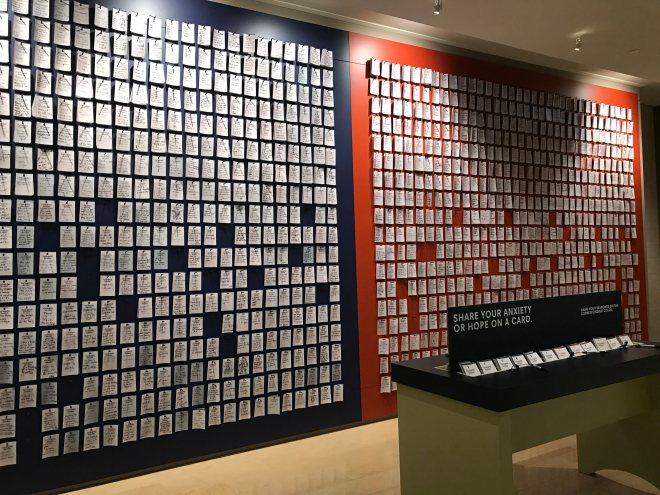
I don’t remember exactly what I wrote. My anxiety card was probably something very serious and parenting related. I probably had more than one. As I browsed through the cards left by the people that came before us, I found many that were very entertaining:
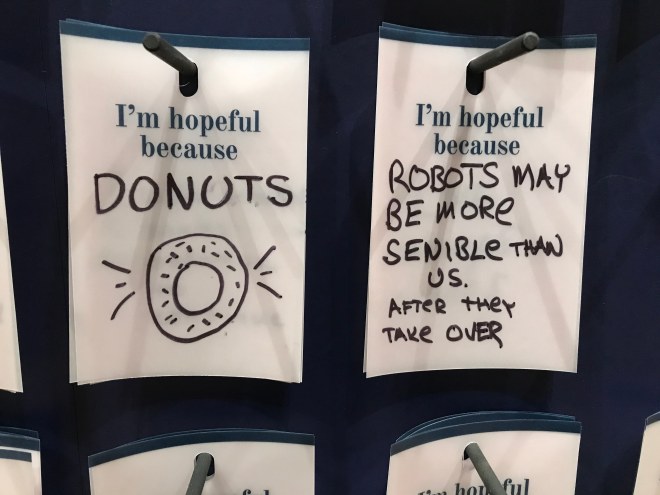 I, too, await our robot overlords.
I remember wondering how many people had written down serious hopes or serious anxieties like me, versus witty ones, silly ones, smart ones. It was the same curiosity that I often feel when browsing through social media and questioning the sincerity of what I’m reading.
The reason I bring up this past exhibit is because the Rubin has done it again, though this time much more high-tech. The Wheel of Intentions, a collaboration between data artist Ben Rubin and Potion Design, is currently up at the museum, in the same big lobby as the hopes and anxiety cards.
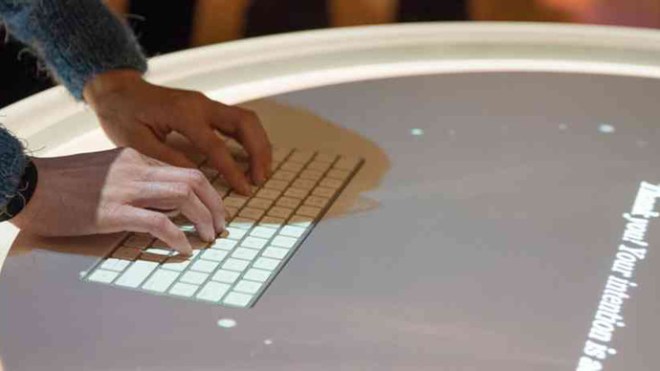 The Wheel of Intentions, courtesy of the Rubin Museum
The Wheel of Intentions is both digital and visual. Visitors can type in their intention on a keyboard, and through their entry move all the intentions up a display on the spiral staircase in the lobby.
You don’t need to physically visit the museum to be a part of this exhibit- you can enter an intention from home, wherever home may be.
I enjoy art that can be interacted with, and I really enjoy art that would be impossible to pull off without some form of new technology. While the wall of cards was fun, there is something magical about screens lining a spiral staircase through which words typed from anywhere in the world are turned into collections of pixels and displayed for all to see.
It makes me wonder yet again, though, about the sincerity of what we portray when we know we are being watched, even when our input is anonymous. It is known that users of social media often create a narrative of how they wish to be perceived, especially if they have managed to monetize their online presence. Does this same manipulation of self apply to new media art like Ben Rubin’s installation?
I think it does. This all made me think about PostSecret, Frank Warren’s blog in which people write secrets on postcards and mail them to him. Some of the cards are very touching and genuine. Most of the time, what makes them seem so genuine is the fact that they are not humble brags or exaggerations, just people processing feelings that we all have had or may encounter someday. While Warren is not an artist and does not make these cards himself, he has published books with their images and shown them at art galleries and museums.
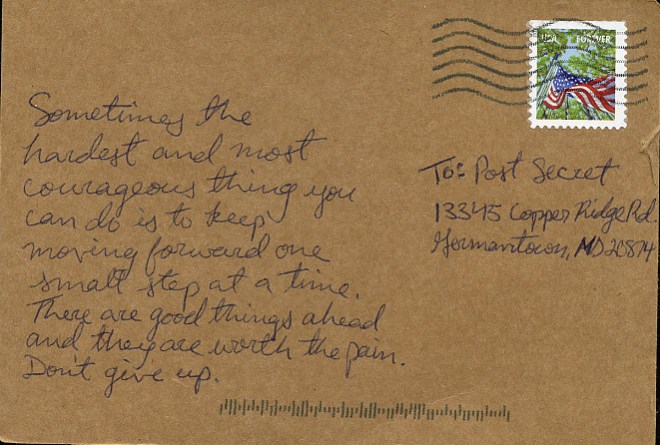 Courtesy of PostSecret
With Ben Rubin’s Wheel of Intentions, however, the theme of the exhibit might influence those who participate into putting their best foot forward. Just as how PostSecret encourages the sharing (purging) of what are often very sad secrets, the word “intention” encourages positivity and self-improvement. While an intention does not equate to action, the whole point (and the concept explored in the exhibit) is the relationship between what we intend to do, and what we’ll actually do.
Who I am, and what I am doing, are often not who I wish I could be, or what I wish I were doing. If I need to set an intention, then I must feel there is a wide chasm between how I perceive myself, and how I wish things truly were. Alternatively, one might feel that their intention is too low-brow, and craft a new one that will sound more sophisticated and in line with what the audience at this exhibit expects to see.
In the end, it’s impossible to tell how genuine the inputs will be. Still, this exhibit is a great example of how the technologies associated with the creation and use of new media are currently being applied to art, how the propagation of this new art in turn redefines the role of the audience, and how that audience can play with self-image and presentation in ways very similar to how we manipulate our online persona across social media.
“Enter Your Intention | Rubin Museum of Art.” The Rubin Museum of Art, 2019, rubinmuseum.org/page/enter-your-intention.
“PostSecret.” PostSecret, 2019, postsecret.com/.
Puente, Maria. “Blogger Gives Dark Secrets First Class Treatment.” USA Today, 14 Mar. 2006, https://usatoday30.usatoday.com/tech/news/2006-03-14-postsecrets_x.htm.
Speed, Barbara. “The Lies of Instagram: How the Cult of Authenticity Spun out of Control.” New Statesman, 13 Nov. 2015, http://www.newstatesman.com/science-tech/social-media/2015/11/lies-instagram-how-cult-authenticity-spun-out-control.
“The Power of Intention – Reinventing the (Prayer) Wheel | Rubin Museum of Art.” The Rubin Museum of Art, rubinmuseum.org/events/exhibitions/the-power-of-intention.
 History and Theory of New Media